AI is moving fast. Very fast.
For organisations, the question is no longer simply whether AI will change the way we work. Increasingly, it is how we make sure that change delivers genuine value – for our organisations, our people and, crucially, our customers.
And that presents a significant opportunity for Quality and Continuous Improvement professionals.
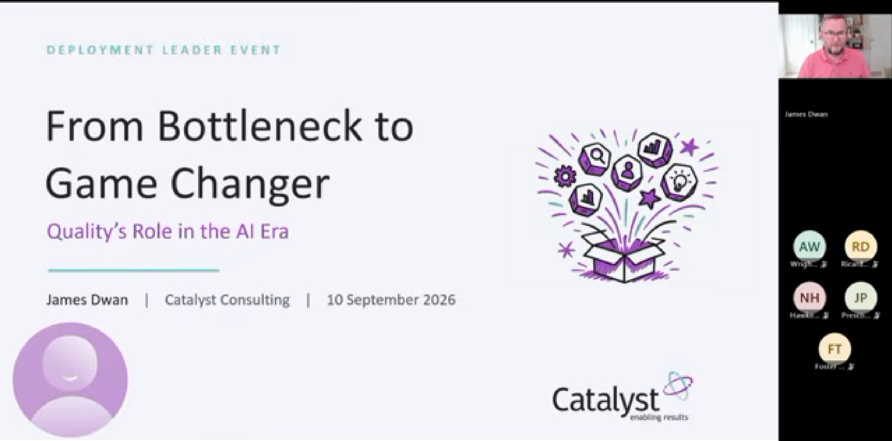
In our recent Back to Better webinar, Catalyst Consulting Chief Executive James Dwan explored why many of the skills that Quality and CI professionals have developed over decades are becoming more important, not less, in the AI era.
AI adoption isn’t just a technology project
Much of the current focus on AI is understandably on the technology itself: selecting tools, building agents, automating tasks and exploring what new models can do.
But organisations also need to consider the people and processes surrounding that technology.
James argues that treating AI adoption simply as another software project risks overlooking exactly the areas that determine whether change succeeds: process, people, measurement, risk, governance and change management.
This is where Quality and CI professionals have a great deal to contribute.
Systems thinking, process management, customer value, risk analysis, measurement and involving people in change aren’t new concepts. They’re fundamental elements of good Quality and Continuous Improvement practice, and they’re highly relevant to successful AI adoption.
Start with the customer, not the technology
One of the biggest traps is starting with the question: “Where can we use AI?”
Start instead with the customer.
What are they trying to accomplish? What do they value? What problem are we trying to solve for them?
Only then should we consider how the process could be redesigned and where AI might – or might not – help.
Sometimes AI will be the answer. Sometimes it will be conventional automation, digital transformation or simply improving an existing process.
As James puts it, when the organisation has an “AI adoption” hammer, every problem can start to look like a nail. Taking a broader value-stream view helps organisations choose the right intervention rather than introducing technology for technology’s sake.
Avoid ‘random acts of AI’
As organisations experiment, there’s a risk of what James describes as “random acts of AI”: isolated initiatives without a clear connection to customer value, organisational strategy or the wider process.
They can produce impressive demonstrations without necessarily creating sustainable business value.
Instead, James recommends starting with a process that matters.
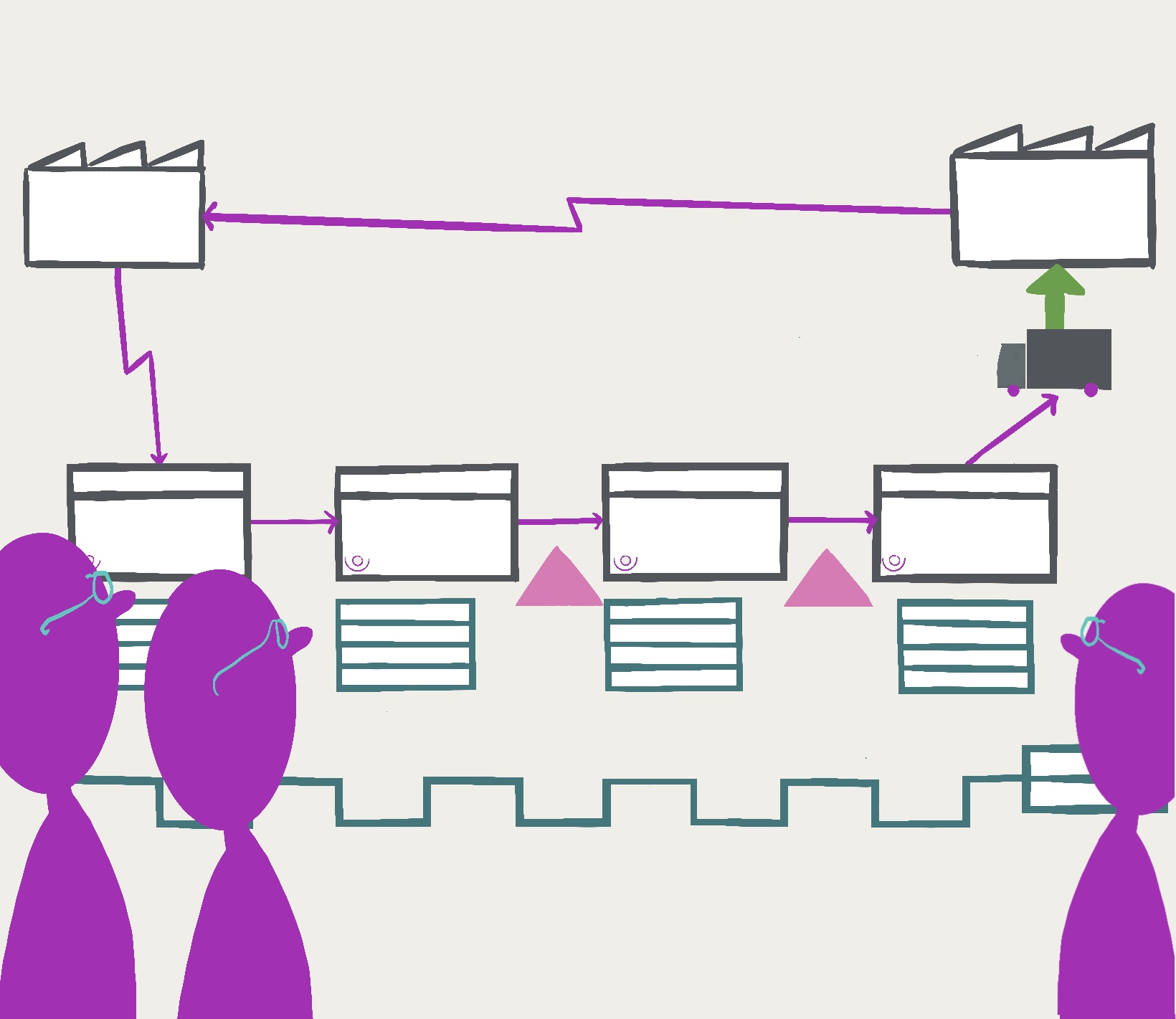
Map it before you automate it. Understand what’s wrong with the process today. Ask what could become possible. Establish what success will look like before you start.
Importantly, don’t automate today’s problems into tomorrow’s process.
These are principles CI professionals already understand.
Humans and machines, working together
AI doesn’t necessarily mean removing humans from a process.
James shares a powerful personal example in the webinar. When making an insurance claim on behalf of his father, AI appeared to handle much of the routine information gathering quickly and efficiently. But when the insurer recognised that his father was vulnerable, a human stepped in.
They called James, checked that his father was okay and asked whether there was anything else they could do to help.
The technology took friction out of the process; the human added empathy and judgement.
For James, it was an example of what AI-enabled operational excellence can look like: humans and machines working together to deliver a better outcome for the customer.
Quality needs to enable, not police
There is another important role for Quality here: helping organisations innovate safely without stifling experimentation.
If governance becomes too restrictive, people don’t necessarily stop using AI. Instead, its use can simply disappear underground, creating even greater risk.
The alternative is what James describes as “guardrails, not gates”: creating clear boundaries within which people are empowered to experiment, learn and improve while ensuring appropriate governance and accountability remain in place.
And accountability matters.
AI agents may become responsible for carrying out parts – or potentially all – of a process. But James argues that organisations should retain clear human accountability for those processes, alongside measures that allow them to understand how both people and AI are performing.
A significant opportunity for Quality and CI
AI can also enhance Continuous Improvement itself.
It can support teams in defining problems, understanding current performance, analysing potential root causes, generating improvement ideas, building solutions and monitoring processes for variation.
For Quality and CI professionals, that creates the potential not only to help organisations adopt AI more effectively, but to use AI to become better at improvement too.
James’s message is therefore a call for Quality and Continuous Improvement professionals to get involved.
The AI revolution is already underway. The opportunity now is to help organisations make sure it delivers better processes, better outcomes and better experiences for customers – while managing the risks that come with such rapid change.
Watch the full webinar
From Bottleneck to Game Changer: Quality’s Role in the AI Era, with James Dwan.